Severance: The Metaphor We're All Living
On Ben Stiller, Daniel Kwan, and the strange thing that happens when a neurodivergent creator builds the metaphor before they have language for it.
by Troy Lowndes - Perth, Western Australia - April 2026
Ben Stiller didn't just direct a quirky Apple TV+ sci-fi show about office drones with split brains. He painted a mirror. Most of us are still refusing to look directly into it.
I've been watching the online discourse around Severance with a strange mix of fascination and dread. On Reddit, on X, in every comment thread, people dissect the corporate satire, the cult vibes, the trauma allegory. Yet so few seem to notice the most obvious, uncomfortable layer. The one that applies to every single one of us scrolling right now.
Before I make the case, let me tell you about the other guy.
The Daniels Problem (and Why It Matters Here)
Daniel Kwan, one half of the Daniels, wrote and directed Everything Everywhere All At Once. He wrote the screenplay. He shot it. He sat through post-production. He won the Oscar.
And then, somewhere along the way, audiences and critics started telling him something he hadn't quite seen himself: the multiverse-jumping, hyperfixation-spiralling, can't-finish-the-laundry-because-the-universe-is-collapsing energy on screen was ADHD energy. Kwan has talked about this in interviews with disarming honesty. He came to recognise his own ADHD around the time of the film. He'd written, in effect, a documentary about his own brain without fully knowing what he was documenting.
The art arrived first. The diagnosis arrived later. The audience handed the meaning back to the maker.
Stiller's Restraint Is the Tell
Stiller is famously understated about his own work. He won't spell things out. He deflects in interviews, lets the show breathe, gives small quotes like "this could be just about life in general" and then steps back. That is not a man hiding a thesis. That is a director who knows the second you name the metaphor out loud, you kill it. The Lynch principle. Trust the audience or don't make the thing.
So I'm not going to claim Stiller consciously sat down and drew up a blueprint titled "Fragmented Neurodivergent Consciousness in the Attention Economy." I don't need to. The Kwan precedent shows the pattern can sit inside the work whether or not it sits inside the maker's stated intent. The restraint is part of the artefact. The understatement is the tell.
What I am going to claim is this. Severance is a thought-provoking metaphor for modern consciousness itself. The way we already live fractured, alternate-reality lives inside our own heads. Especially those of us who are neurodivergent, or simply hyper-engaged with the digital feed. The MDR team isn't doing meaningless data entry. They're separating scrambled clusters of emotion into bins, and most of us do something very similar every time we open another tab.
1. The Split: Consciousness, Beaming and Alternate Selves
The elevator ride isn't just a plot device. It's a literal beam between two states of being. Star Trek style. Two versions of you, sharing one body, one chip, one timeline, never able to share the full log.
This isn't only a work-life balance satire. It maps cleanly onto:
- Neurodivergent masking. The professional "innie" persona you switch on at 9 a.m. that feels alien to the unmasked self at home.
- Dissociation and fragmented identity. Parts of self that feel severed from the rest, especially after grief or trauma. Mark and Gemma is the clearest example.
- The eternal present. The innies have no exit. Their entire existence is the severed floor. They can't go home, can't see weather, can't hold onto a Tuesday because there is no Tuesday for them. It is workplace continuity with no horizon. If you've ever lived inside a hyperfixation, or inside a depressive flat-time, you know what that feels like from the inside.
"This could be just about life in general... what are we all doing here?" - Ben Stiller
Read that with Stiller's understated voice in your head. He's not deflecting. He's pointing.
2. Echoes of Other Worlds
Severance doesn't exist in a vacuum. It feels like a deliberate convergence of cultural touchstones, each one sharpening the metaphor:
- Black Mirror. The cold, tech-enabled horror of fragmented selves and corporate-controlled consciousness. The severance chip is pure Black Mirror tech: invisible, intimate, soul-crushing.
- Groundhog Day. The repetitive, memory-flat loops that force existential awakening. The innies live inside a fluorescent present with no past to anchor against.
- The Truman Show. A fabricated reality staged for someone else's benefit. Lumon's severed floor is the ultimate soundstage. The innies are Truman, slowly noticing the walls.
- The Office. The warm, sitcom-style camaraderie that makes the prison feel almost cosy. The MDR team's banter, perks and group dynamics mirror mockumentary absurdity, until the dread creeps in and you realise the laugh track is corporate gaslighting.
- Eternal Sunshine, The Matrix, Philip K. Dick. Memory as battleground. Reality as construct. Identity as something that can be edited from the outside.
Stiller weaves them all into one cohesive warning. We are already living inside the mash-up.
3. MDR: Sorting the Scrambled Soul
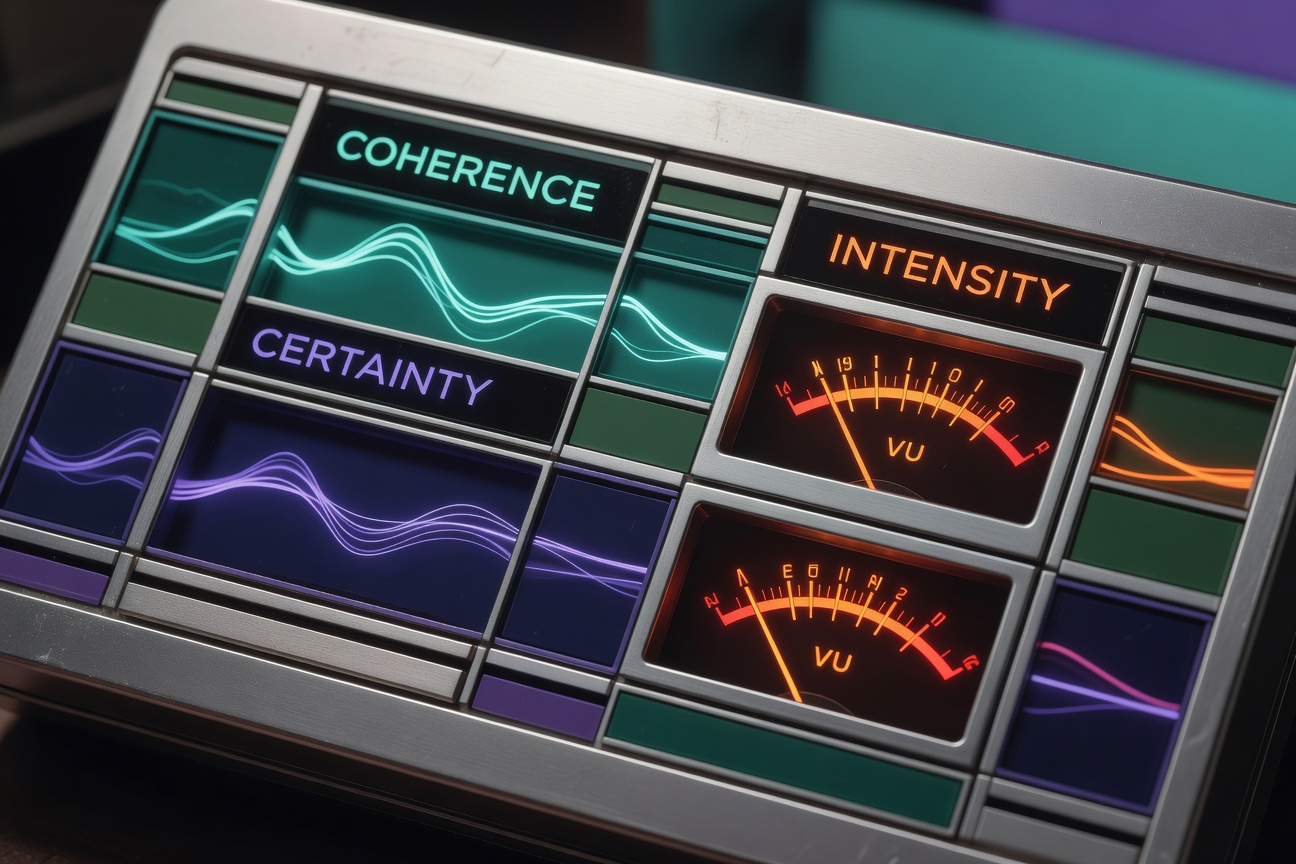
Here's where it gets electric. The Macrodata Refinement team doesn't sort 1s and 0s. They feel clusters of numbers that evoke gradient emotions. The Four Tempers: Woe, Frolic, Dread, Malice. Each cluster is colour-coded on screen. Refiners separate the scary numbers from the tender ones, the malicious from the playful, bin by bin, until the file is "balanced."
Season 2 makes it explicit. Those numbers are building blocks of a human mind. They're refining consciousness itself. Taming the messy, multi-axis soup of human experience into something Lumon can control.
Points are awarded. Quotas are met. Little dopamine hits for a job well done.
Now look at your own screen. Every Reddit thread, every X reply chain, every comment section. We are all MDR workers now. We scroll through the scrambled feed of human emotion, fear, rage, joy, conspiracy. We sort it into mental bins: this is satire, this is trauma, this is the real signal, this is bait. We award ourselves points (karma, likes, retweets). Our heads get more scrambled the deeper we go, yet we keep refining, because the algorithm (Lumon) rewards the sorting.
I work on a framework called Spectral Binary, which tries to read tone across multiple axes rather than collapsing it into positive-versus-negative. Watching MDR is uncanny for me, because the show is doing the visual version of what I keep trying to articulate in code. Emotion isn't binary. It is a constellation. The horror of Lumon is that they've found a way to make it binary anyway, by pretending the bins are real.
4. The Audience Is Part of the Mechanism
Here's the recursive bit, and I want to own it cleanly.
The people most obsessed with decoding Severance, the ones neck-deep in theory threads at 2 a.m., are also the people whose attention is most fragmented in the first place. That includes me. That probably includes you, if you've read this far.
I am aware this is exactly the kind of pattern recognition a refining innie would do. Sit at the desk. Stare at the cluster. Decide which numbers feel like the real signal. Award yourself a point for noticing.
I don't think that invalidates the reading. I think it is the reading. The Kwan precedent suggests that the audience finishing the meaning is part of how this kind of art actually works. The work arrives. The recognition arrives later, through people who happen to share the wiring the work was unconsciously made of. That's not a conspiracy. That's resonance doing what resonance does.
Final Thought
Stiller didn't build a puzzle box. He built a mirror, with the discipline not to label it. Kwan showed us, in a different register, that creators can paint themselves into a film and only meet the painting afterwards.
So next time you're seventeen tabs deep in Severance theories at 2 a.m., the question isn't "what does the show mean." The question is which version of you is doing the refining right now, and who is the outie waiting on the other side of the elevator.
Written as a hypothesis after two seasons. Feel free to share, refine, or push back. The numbers are watching either way.
#SeveranceIsUs #ResonanceFirst #ToneThread