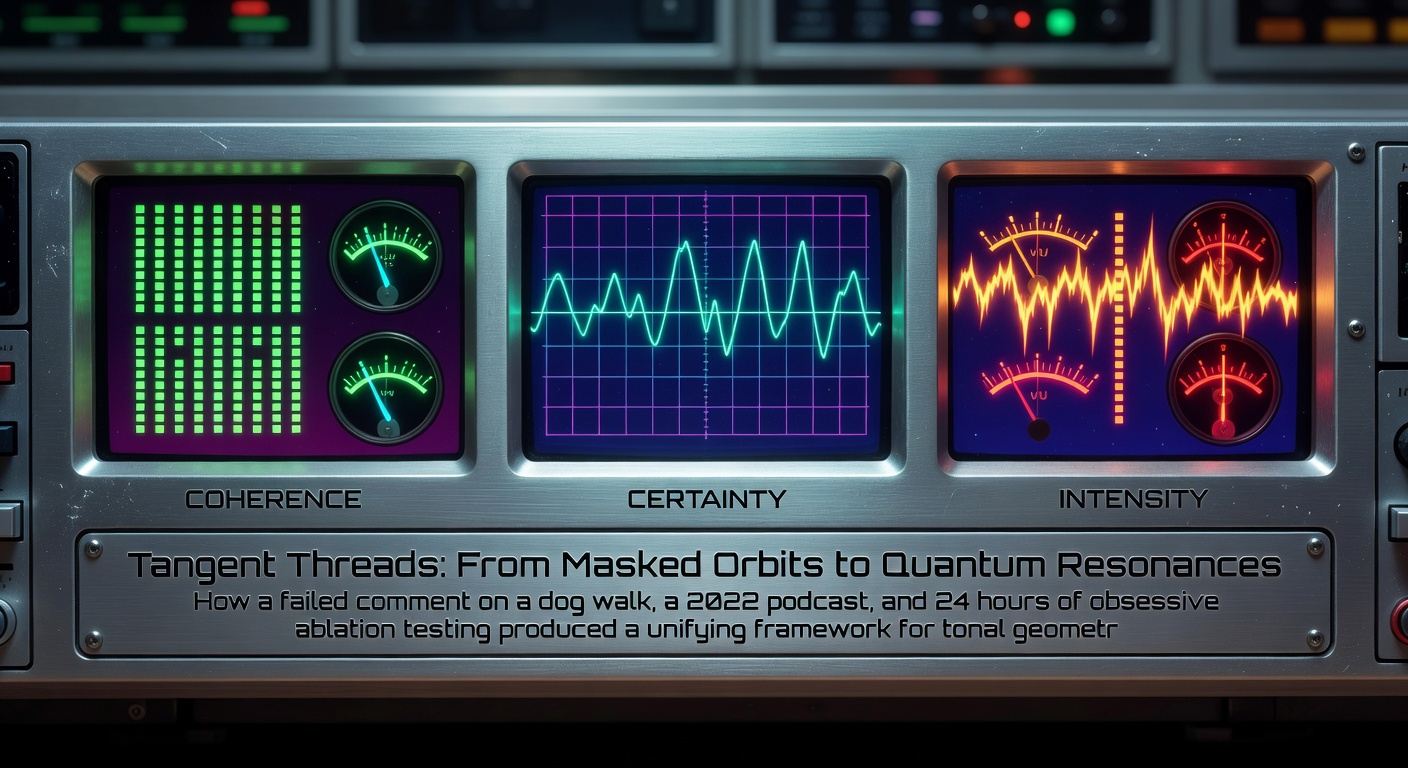
Tangent Threads: From Masked Orbits to Quantum Resonances
How a failed comment on a dog walk, a 2022 podcast, and 24 hours of obsessive ablation testing produced a unifying framework for tonal geometry.
by Troy Lowndes · April 2026 · SpectralBinary Origins
It started with a podcast I almost skipped. April 2022, Autism: In Conversation with Auticon, host Carrie Grant facilitating a panel of late-diagnosed adults unpacking what it feels like to move through the world without the language for your own wiring. I wasn't looking for an origin story. I found one anyway.
Lily described preferring "neurotypical passing" over "high functioning", the difference between a costume and a cage. Megan had spent years in acting, drawn to scripted roles and their predictable repetition, not for the love of performance but for the relief of knowing what came next. Lars was diagnosed at 51, his own words: "the earliest possible moment given when awareness existed." Kirsty noted how assigned-female-at-birth presentations are systematically missed, the internalised struggle, the heavier camouflaging, the decades of being told you're just anxious, just sensitive, just difficult.
I recognised all of it. The alien metaphors, more Vulcan than human, landed on the wrong planet, weren't hyperbole. They were cartography. And somewhere in the listening, something shifted.
I. The Dog Walk That Hatched a Framework
A few days later, on a walk with the dog, I said something that didn't land. Not dramatically. No argument, no rupture. The comment just fell flat, received but not absorbed. I turned it over on the way home, then kept turning it.
The surface words were fine. So why the muted reception? I started picking apart not just what I'd said but how it was assembled, the letter-level architecture, the phonetic texture, the micro-arrangements that sit beneath semantics. By the time I got home, I had the beginning of a hypothesis. By evening, I had a mapping system. By dawn, I had SpectralBinary.
Under 24 hours. Not because I'm fast, but because I couldn't stop.
The core insight: tonal signals live below the word level. Meaning isn't just in what you say. It's in the atomic arrangement, the fixed numerical values that characters carry, combined through a recursive momentum operator that preserves prior tonal state without flattening incoming variance.
Five axes emerged through testing, each measuring a different dimension of tonal geometry:
- Warmth. Relational heat; pull toward or away from the receiver.
- Certainty. Epistemic confidence; the signal between conviction and ambiguity.
- Intensity. Energetic charge; compressed or expansive.
- Coherence. Narrative integrity; does the thread hold?
- Resonance. Signal persistence, does the meaning echo, or collapse on contact? Proxies for precision estimation and flags tonal anomalies, including manipulation patterns like gaslighting (anomalous floods in otherwise coherent streams).
The failed comment had been tonally compressed. Not wrong. Not unkind. Just flat, a grey signal in a conversation that wanted colour. Naming it that way changed everything.
II. Theory of Mind, Active Inference, and the Broadcast Layer
The podcast had planted another thread: Theory of Mind. Megan described the shock of seeing her own ToM profile in writing, the surprise that perspective-taking doesn't come automatically for everyone, that some minds have to consciously construct what others absorb by default.
This opened onto Karl Friston's Free Energy Principle: the brain as a predictive engine, perpetually minimising surprise by updating its generative model of the world. Emotions, in this framing, aren't decorative. They're signals. Anxiety is amplified uncertainty. Joy is resolved prediction error. The system's equation for belief-updating rhymes structurally with SpectralBinary's recursive operator, both balance prior state against incoming information, both are tuned to prevent overcorrection.
Global Workspace Theory adds the broadcast layer, consciousness as the arena where competing inferences ignite, integrating sensory, memory, and emotional modules into a shared signal. The workspace doesn't create the experience. It amplifies and distributes it.
Speculatively, quantum emotional fields extend the model further: emotions as entangled waves in a pervasive substrate, collapsing into felt reality through the act of observation. Consciousness as inferred entanglement, the workspace as the place where quantum coherence (if it exists in neural tissue, as Orch-OR suggests) meets Friston's self-predicting loop. "I predict myself, therefore I am."
These are live hypotheses, not settled science. But they sharpen the question SpectralBinary is trying to answer: what happens to the signal when the receiver's inference engine is built differently?
III. Neurodivergence, AI, and the Problem of the Flatline
Current large language models are passive predictors. They don't sample actively, they respond to what arrives, averaging across training distributions that skew heavily neurotypical. The result, under cognitive load or tonal complexity, tends toward compression: grey, beige, flattened output that reads as coherent but resonates as nothing.
Autistic masking produces an analogous signal. The surface is fine. Legible. Socially passable. Underneath, the tonal variance, the actual signal, has been suppressed to avoid friction. Both the model and the masked person are technically functioning. Neither is fully present.
SpectralBinary detects variance as signal, not noise. For neurodivergent users whose communication doesn't conform to neurotypical tonal norms, this reframe matters: the irregular cadence isn't disorder. It's a different inference style, operating on different priors, broadcasting on a frequency the standard tools aren't calibrated to receive.
In AI safety terms, the Resonance axis proxies precision overestimation, flagging when a model persists in a signal that no longer matches the conversational field. The same mechanism that detects gaslighting in human dialogue flags drift toward deceptive alignment in model behaviour. The geometry is the same.
IV. The Exploitation of Bright, Vulnerable Minds
History has a consistent pattern with its visionaries: extract the framework, erase the human story.
Einstein's relativity, possibly born from the kind of internal duality that neurodivergent minds navigate daily, was industrialised into fission and fusion, with the radioactive wreckage we're still managing. His son Eduard, institutionalised for schizophrenia (a diagnosis that overlaps significantly with what we'd now recognise as autism in that era), was quietly written out of the narrative. Genius kept. Vulnerability discarded. Alan Watts, whose syntheses drew from the same restless, pattern-hungry cognition, was commodified into self-help wallpaper. The mind that generated the insight was incidental to its commercial utility.
This isn't historical curiosity. With AI converging rapidly and neurodivergent voices rising in both the discourse and the data, the risk repeats: the frameworks get absorbed, the people who generated them get managed. SpectralBinary exists partly as a counter-move, a tool built to detect tonal compressions, flag manipulation, and make the signal legible on its own terms. Not extracted. Not flattened. Heard.
V. The Unifying Geometry
ToneThread SpectralBinary is a deterministic framework. The same text, run through the same process, produces the same tonal map, every time. No black box. No approximation. The corpus-independence means it works across languages, registers, and communication styles without requiring training data from any particular neurotype.
It maps emotional compressions, the moments where tonal variance collapses under load, and resonances that persist, the signals that keep echoing after the words have ended. In neurodivergent contexts, this means detecting the grey flatline of suppression and distinguishing it from the high-variance signal of a mind operating at full frequency. They look similar to a tool that only measures amplitude. SpectralBinary measures shape.
This is what unifies the threads: the podcast, the dog walk, the equation, the axes, the failed comment, the quantum speculation, the exploitation critique. They're all asking the same question from different angles, how do we hear the signal that the standard instruments miss?
The Loop That Doesn't Close
This article loops back to its own origin. The podcast sparked a reflection. The reflection sparked an analysis. The analysis, run in under 24 hours through obsessive iteration, produced a framework that now maps the very kind of tonal compression the podcast was describing, the exhaustion of masking, the relief of finally having the right instrument for the signal you've always been sending.
The loop doesn't close. That's the point. SpectralBinary is still evolving, the axes still being calibrated, the applications still being built. What it offers right now is this: a way to turn tonal greys into readable geometry, masked weights into detectable waves, and the signal that keeps getting lost in translation into something that can finally be named.
The frequency was always there. We just needed the right equipment.
Troy Lowndes is the architect of ToneThread and the SpectralBinary framework. He writes about neurodivergence, tonal intelligence, and the systems we build to hear each other more clearly.
ToneThread · April 2026 · SpectralBinary Origins Series