For a long time, I confused relief with regulation.
I suspect I am not unusual in that.
When something makes the noise stop, even temporarily, it is easy to assume the thing has helped.
Sometimes it has.
But there is another possibility.
Sometimes it has simply made the instrument harder to hear.
That distinction took me decades to recognise.
There were things I reached for because they softened the edges.
Things that lowered the volume.
Things that made social situations easier, thoughts less persistent, boredom less abrasive, intensity less intense.
Some were substances.
Some were habits.
Some were behaviours so ordinary they barely registered as behaviours at all.
Some were probably reward.
Some were avoidance.
Some were stimulation.
Some were sedation dressed as recreation.
And some were simply what people around me had always done.
That matters.
Because we often inherit ways of coping before we inherit any language for what those coping mechanisms are trying to manage.
A family may pass down humour.
Silence.
Work.
Alcohol.
Anger.
Stoicism.
Restlessness.
Hypervigilance.
The inability to sit still.
The inability to stop.
The conviction that exhaustion is normal.
The belief that needing anything from anybody is weakness.
These things travel.
Sometimes culturally.
Sometimes behaviourally.
Sometimes through attachment and modelling.
Sometimes, perhaps, through biological pathways researchers are still trying to understand.
But whatever route they take, they can arrive early enough to feel less like strategies and more like personality.
That is the dangerous elegance of them.
You do not necessarily experience yourself as coping.
You experience yourself as yourself.
Then one day you remove something.
And the room changes.
Not immediately.
Not neatly.
Sometimes the first thing you discover is that what you thought was helping was also obscuring.
The volume returns.
But so does detail.
That distinction became increasingly important to me.
Because alexithymia is not necessarily about having too little emotion.
It can involve difficulty identifying, differentiating and describing emotional states, even while those states themselves remain very much present. Contemporary research increasingly treats emotional awareness as something with multiple components, including bodily sensation, interpretation and representation, rather than as one simple internal readout.
That description makes much more sense to me from inside the experience.
The difficulty was not always that nothing was happening.
Often too much was happening at once.
The body had information.
The room had information.
Memory had information.
Sound had information.
Other people had information.
My nervous system appeared to be taking in all of it.
But information is not the same thing as understanding.
A thousand signals arriving together do not automatically become meaning.
Sometimes they become noise.
And if you spend years finding ways to mute the noise, you may get very good at functioning without ever discovering what the signals were trying to tell you.
That is where the difference between numbing and regulation becomes important.
Numbing says:
make it stop.
Regulation says:
help me remain here while it is happening.
Recognition says:
what is this?
Those are three different operations.
I had spent years treating them as though they were interchangeable.
They are not.
The first reduces access to the signal.
The second changes the conditions under which the signal can be tolerated.
The third begins to interpret it.
And I think that distinction helps explain something about alexithymia that is otherwise difficult to describe.
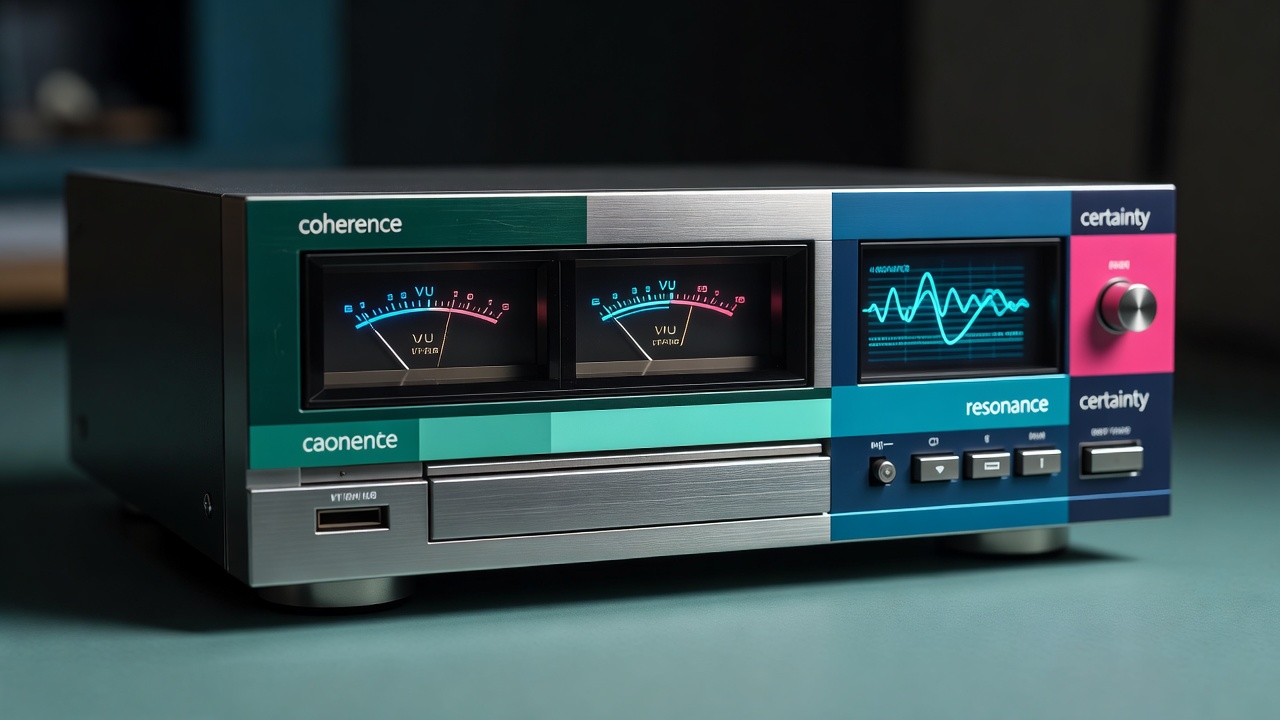
Imagine an instrument panel with twenty gauges.
You know something is wrong because alarms are sounding.
But nobody ever taught you what the gauges measure.
So you learn how to disconnect the speaker.
Silence.
Relief.
Problem solved.
Except the gauges are still moving.
Years later, somebody helps you reconnect the system.
The alarm returns.
At first it feels worse.
Then, slowly, you begin to notice that the gauges are not random.
This one rises when you have not eaten.
This one moves in crowded rooms.
This one responds to confrontation.
This one changes when somebody’s words and tone do not match.
This one appears hours after an interaction you thought had not bothered you.
This one is grief.
This one is fear.
This one is anger.
This one is anticipation.
This one still does not have a name.
That is a very different experience from emotional emptiness.
It is closer to learning instrumentation.
And once I began looking at myself this way, another assumption started to fall apart.
The assumption that sensitivity itself was the problem.
For much of my life, sensitivity had been treated as something to manage down.
Too reactive.
Too intense.
Too distracted.
Too affected by noise.
Too aware of tone.
Too bothered by inconsistency.
Too quick to detect when something in a room did not fit.
But what if sensitivity is not inherently dysfunction?
What if sensitivity is measurement?
A microphone is not defective because it picks up sounds another microphone misses.
It may simply require different filtering.
Different gain.
Different processing.
Different conditions.
That idea matters to me because it changes the question.
Instead of asking:
How do I become less sensitive?
I can ask:
What is this sensitivity detecting?
Instead of:
How do I shut this down?
I can ask:
How do I remain present long enough to understand it?
And instead of:
Why can I not tell you how I feel?
I can ask:
What information is present before the feeling becomes a word?
That last question may be the one that matters most.
Because once you begin separating signal from label, alexithymia starts looking different.
Not simpler.
More interesting.
The gap between sensation and language stops looking empty.
It becomes crowded.
And perhaps that is where the real work begins.
Not by forcing a word onto the experience as quickly as possible.
But by learning to stay with the signal long enough for its structure to emerge.