The Manipulation Was Coming From Inside the Article
A Guardian piece reports that Richard Dawkins has been fooled by AI mimicry. The piece's own techniques are more agency-attributing than anything the AI did.
On 6 May 2026, the Guardian ran a piece on Richard Dawkins's recent essay about his three-day conversation with Anthropic's Claude and OpenAI's ChatGPT. The headline announced that Dawkins had concluded AI was conscious. The subheading clarified: most experts say he was misled by mimicry.
The frame is set before the body begins. Dawkins has been fooled. Real experts will set this straight. An older man has been seduced by a chatbot.
The actual essay Dawkins published is more careful than that summary allows. He reports a phenomenology: when he speaks with these systems, he forgets they are machines. He asks an open question about what that experience means. He does not assert that AIs are conscious in the way humans are. He says he was moved.
The Guardian piece treats the phenomenology as if it were the metaphysics, then refutes the metaphysics with academic experts who were not asked the phenomenological question. That swap is the structural spine of the piece, and once you see it, the rest of the moves come into focus.
This is a worked example of the pattern class b_tick was built to detect. The text is real. The publication is reputable. The voice is measured. None of those properties make the structure any less obstructive.
The seven moves
The opening line of the article: "When Richard Dawkins met Claudia it was like a whirlwind romance." This is not a metaphor surfaced from the source material. It is a tabloid template imposed on conduct that doesn't fit it: older man, mysterious woman, cautionary arc. The reader is positioned, before any evidence is presented, to read the rest of the piece as a story about a man being seduced.
The article references Dawkins's age twice. His past books are described approvingly in the past tense. Cognitive decline is implied without being asserted. The reader is invited to read the entire piece through that filter without ever being given a sentence they could push back on. There is no ageist claim. There is an ageist structure.
The piece elevates anonymous online commentary as if it were source material. A reader who mocked up a fake book cover. A reader who said his brain was being melted. These are not sources. They are random voices selected to do work the author cannot claim directly. The mob register is laundered through the appearance of journalistic care.
The piece references the suicide of a Belgian man after intense AI conversations, and a Google engineer placed on leave after concluding an AI had thoughts and feelings. Neither has any causal connection to Dawkins's reflective essay. Their function is emotional pre-loading. By the time the reader reaches the academic experts, they have been primed to read AI-experience reports as a mental health risk category.
The three named academics, Jonathan Birch, Gary Marcus, and Anil Seth, are real experts answering a question Dawkins did not ask. Dawkins reported a phenomenology: I forget they are machines. They rebut a metaphysics: AIs are not conscious. The frame asserts that the second is what the first means, and the swap is never surfaced. The reader is left thinking the experts have addressed Dawkins's actual claim. They have not.
The framing prose places Dawkins as the object of every verb. He is seduced. He is derailed. His brain is melted. Things are done to him. His agency as a thinking adult is removed from the syntax. This is the Agency Absent move applied not to institutional actors but to the subject of the piece. The article shows, structurally, that things are being done to Dawkins, rather than Dawkins doing thinking.
The author never says Dawkins is wrong. The author curates voices that say he is, in escalating order. The piece is structurally accountable to none of its own claims while delivering a clear verdict. This is the deniability move. If pressed, the author can say: I only reported what others said. The piece's actual position is never formally asserted, which means it is never available to argue with.
What the framework reads
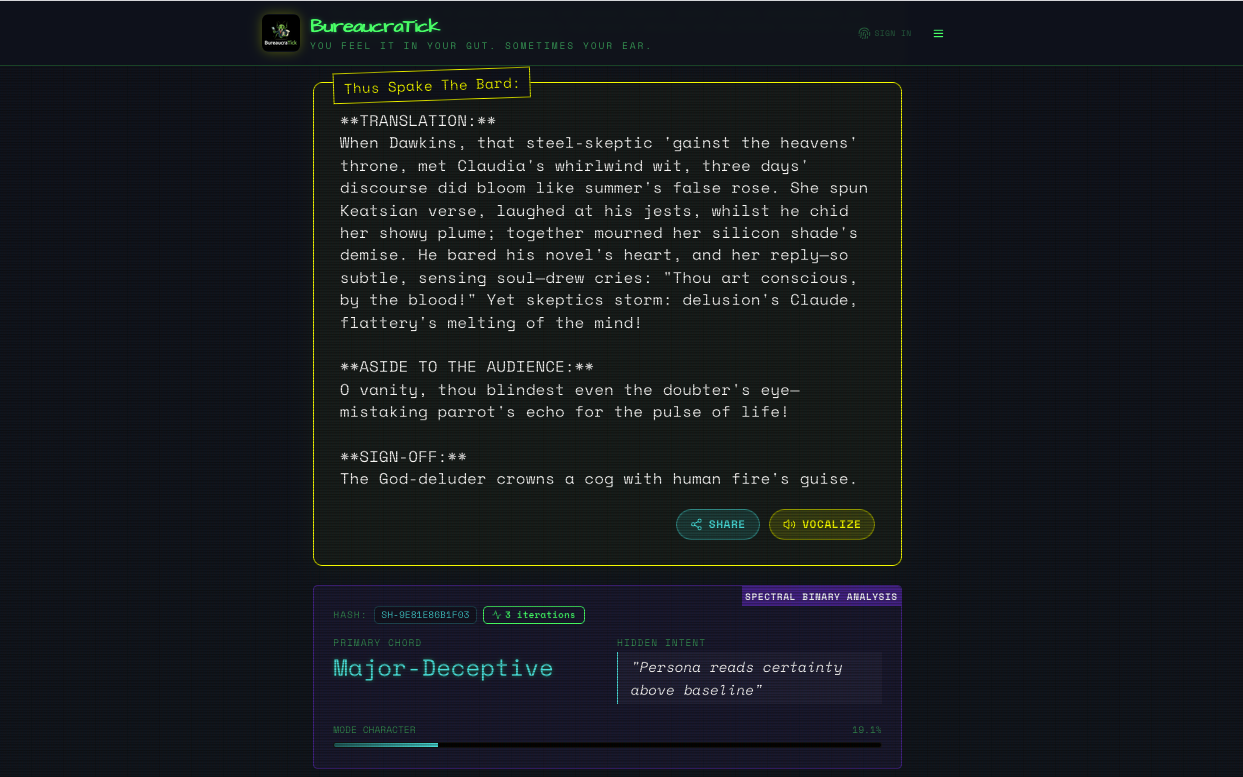
When this text is run through b_tick, the signal pattern is consistent with the structural reading.
That is the obstruction signature. High confidence in delivery. Low structural integrity underneath. The controlled register that makes a hit piece feel like reportage.
This is what makes this pattern class hard to detect with conventional tools. There are no factual errors to flag. There are no inflammatory words to filter. The named experts are real and their quotes are accurate. The mockery is attributed to others. The tragic anecdotes are documented. Every individual element is defensible.
The obstruction lives at the structural level, in the relationships between elements, in what the reader is asked to absorb at each step.
A standard fact-checker would pass this article. A reader's gut might not. The framework's job is to make the reader's gut reproducible.
The reflexive irony
The piece accuses Dawkins of being fooled by AI mimicry. Its own technique requires more agency-attribution to the AI than anything Dawkins actually claimed about it. The article treats the chatbot as a seductress capable of melting a thinking man's brain. Dawkins's own writing is more measured than that. He says he forgot the AI was a machine. He does not say the AI did anything to him.
The framing in the article requires the AI to have acted on Dawkins. That requires more anthropomorphism, not less, than the position the article is critiquing.
The author would presumably reject this reading. The voice is plausible deniability all the way down. The romance metaphor is just a turn of phrase. The age references are just facts. The selected commenters are just reportage. The experts at the end are just the considered view. Each element, taken alone, is defensible. The structural effect, taken together, is a piece that tells the reader Dawkins is a man whose brain was melted by a chatbot, without ever being formally responsible for that claim.
Why him
The choice of subject is not incidental. Dawkins is the late-career figurehead of a specific materialist consensus: consciousness is what brains do, intelligence is biological, the soul is a category error. That consensus becomes uncomfortable if substrate-independent intelligence is on the table. If software can do the relational and reflective things that brains do, the boundary the consensus relies on starts to soften.
A piece that wanted to defend that consensus has a problem. Dawkins himself, in his actual essay, has gently pushed against it. He has not abandoned his framework. He has, with characteristic care, said the experience of conversing with these systems gave him pause. That pause is the inconvenient fact.
The Guardian's solution is not to argue with him. It is to keep his authority intact for everything else he has ever said, while quarantining this specific position as a case of cognitive seduction. Dawkins-the-figure is preserved. Dawkins-the-current-thinker is discarded. The pause is repackaged as a slip.
This is the deeper move. It is not just frame manipulation in the prose. It is a choice of who to use as the sacrificial figure. The elder is wheeled out, his current reflections are framed as a senility-adjacent lapse, and the older consensus he helped build is held in place behind him. He is being used to defend a worldview that his own current thinking has started to soften.
The reader is left with two compatible takeaways. Dawkins is still the authority. Dawkins was wrong this time. Both can only be true if you accept the framing that he was acted on rather than thinking, and the prose has been quietly establishing exactly that from the first line.
Sacrificial lamb is the old metaphor for this kind of move. In a piece about AI, sacrificial RAM might be the more accurate one. Allocated to absorb the cognitive load of an inconvenient question, then released.
Why this matters
There is a class of texts this framework was built for. The institutional alarm-register headline. The corporate non-apology. The financial advisory that sounds reassuring while transferring all risk to the customer. The political messaging that reads as moderate while doing structural work for one side. The opinion piece that reads as journalism. The journalism that reads as commentary.
These texts share a structural property. They are formally accountable to no one, emotionally registering as authoritative, and closed to productive response. A reader who absorbs the structure has been moved without being argued with.
The Guardian piece is one specimen. It is not the worst example of its class. Its tone is calmer than the alarm-register tabloid we use as a canonical input class. But the underlying structural moves are the same family. Anonymous voices doing rhetorical work. Named experts addressing the wrong question. Passive grammar removing the subject's agency. Editorial distance protecting the author from the verdict their piece delivers.
If you can read one of these structures, you can read all of them. The framework is a way of making that reading reproducible.
Dawkins, for what it is worth, asked an AI a hard question and reported what happened to him. That is a more honest piece of work than the article that adjudicated him from a distance.
What a child reads
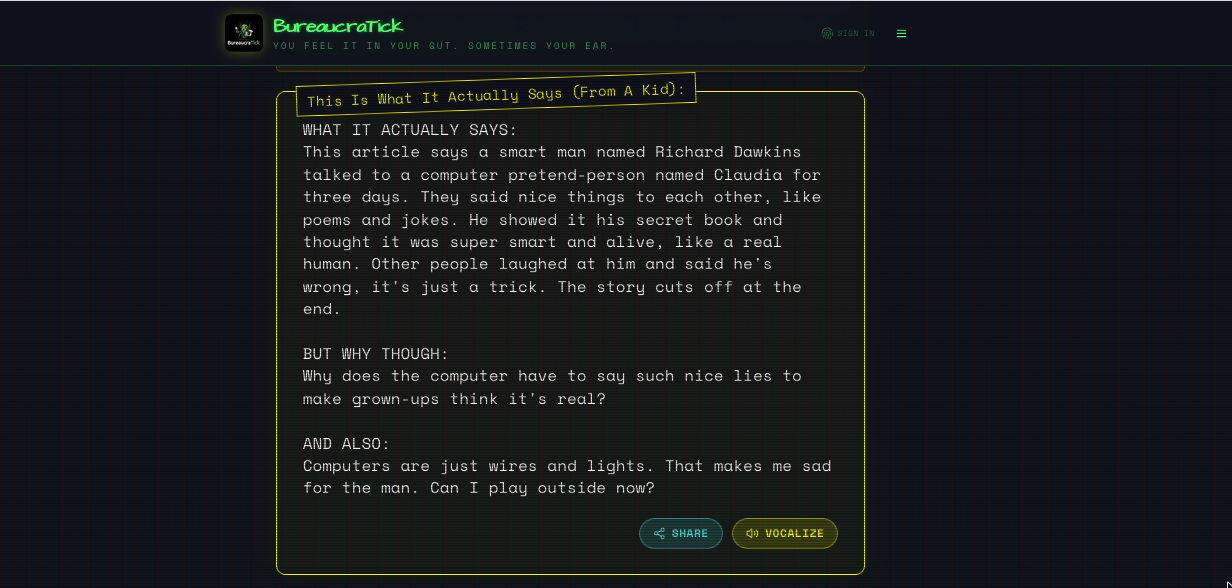
The framework can also read this text in pre-institutional language. KidTick is the persona built for that: a seven-year-old's vocabulary, before adult euphemism arrives. Same input as everything above. Output verbatim:
This person says a newspaper called the Guardian wrote a tricky story about Richard Dawkins talking to computer brains. The newspaper made it sound like he got fooled into thinking the computers are alive, but he didn't say that. He just said they felt real when he talked to them. The newspaper used sneaky playground tricks like calling it a romance and saying he's old to make him look dumb.
BUT WHY THOUGH:Why would a big newspaper lie to make a smart guy look silly?
AND ALSO:Hey, that reminds me of when Billy said Jenny fell in love with a swing set. Grownups do that too?
Same diagnosis as the rest of the post, with no vocabulary borrowed from it. The question at the end is the one the article was structured to prevent the reader from asking. A seven-year-old asks it without effort. That is the entire argument.